Louise Kelly
“Painting the Humble Potato as a Portrait – Oils”
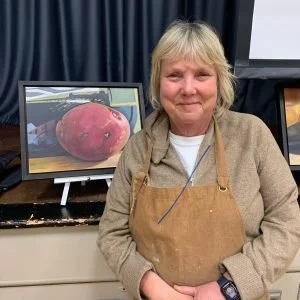
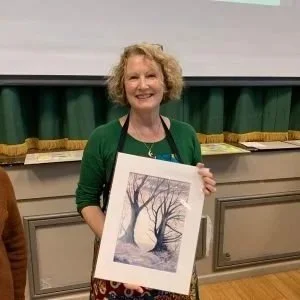
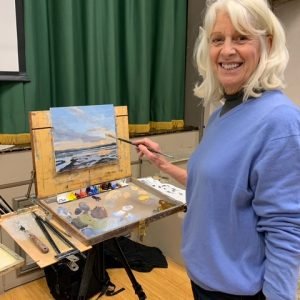
Well done to everyone who braved the windy weather today… we all blew into the hall like Mary Poppins on Sanatogen, but it was well worth it as our artist today was the very engaging Louise Kelly accompanied by a potato. Now I like a like a potato as much as the next man but I didn’t think staring at one for 2 hours was going to be that interesting… how wrong I was! Louise happily painted away while sharing amusing stories and invaluable tips… in fact this demo was more like a stand up monologue while just happening to paint a potato…much like the rest of us might chat while making a cup of tea. Effortless for Louise.
Louise started off by explaining her preference for MDF board as it doesn’t bounce like canvas. She prepares her boards with 3 layers of paint, the first being gesso, then her ‘vinegar’ layer, a solvent mixed with paint and finally an under painting in acrylic. Unusually, the background inspiration used for Louise’s potato portraits is often paintings by other artist with the same name as the potato variety she is painting. I think this says a lot about Louise’s sense of humour…I wonder who she chose for the ‘Pink Fir and Blue Salad’ variety?
Starting the oils, the first colour mix for the Desiree potato was Zinc white + Titanium White + Yellow Ochre. This started a wonderful waterfall of tips and anecdotes… the flow starts here. Always mix with Zinc White as it drops the opacity of colours. Titanium White should be saved for final highlights as its a chalky. Work from thin paint to thick… think of milk, cream, butter. The first acrylic layer was the milk. The second thin oil layer was the cream. The third thick oil layer was the butter. Yum!
Louise uses all brands of paint but likes to finish with Michael Harding, Windsor and Newton or Old Holland as the pigments are much better. Using a little Linseed Oil in your solvent towards the end of the painting enriches the colours. Brushes are purchased from South West Art Materials and Louise likes the Bristle Line synthetic brushes, remarking that they have a nice ‘bounce’. These she cleans with Olive Oil soap which is also kind to your hands. (Tip form me, your friendly felter… Felters also like it because it doesn’t create lots of suds.) Tear-off paint palettes can be purchased cheaply from The Works. Compartment pill boxes can be used to store paints in the freezer
When painting a potato, look for the ‘character’ or ‘face’… the way the eyes and marks occur. Tone colours down with their opposite colours. Shadows are always the opposite colour to the item creating the shadow. Especially when working on the shadow beneath the potato. To make a round item look solid add a little ‘bounce’ of light on the bottom curve, against the dark shadow. Work on more than one piece or art at a time to allow oils to dry in between layers. After about two weeks drying, oil paintings can be finished with archival spray matt varnish. This can if needed be removed at a later date and is sometimes referred to as exhibition varnish. And lastly, and at this time of year probably the best tip of all… When working plein air… wear a heated body warmer like your best friend, artist Dawn Jordan. You can see more of Louise’s work on her website and social media.