Joan Prowse
“NEEDLE-FELTED LANDSCAPE IN WOOL”
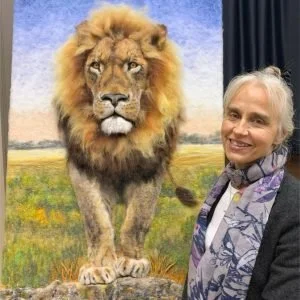
Today we welcomed wool artist Joan Prowse into our friendly little gathering and what a feast for the eyes it was! Not only the eyes… but fingers too! How many of us picked up those little bundles of poodle yarn and gave them a wiggle.Joan had a Wonderfull range of finished artworks to share with us from small 2D landscapes to a huge 3D relief of a lion, which was just back from exhibition in Ireland.As Joan had brought so much for us to look at, this demo turned into more of a questions and answers session covering everything from 2D work to 3D animal sculptures.
So here is a reminder of what we learned.
Joan explained that needle felting is the practice of creating either 2D or 3D artworks from wool and man made fibres using a needle and a stabbing action to mesh the fibres together.
Felting needles are very sharp and have two sets of barbs along each edge which catch the fibres (usually wool) and force them into your base fabric.
Wool, like human hair is covered in minute scales and it’s these scales that the barbs of the felting needle catch on. The repeated stabbing motion with the needle causes the scales to catch and tangle and ultimately mesh together. The more you stab the more the fibres mesh and the firmer the wool fabric becomes.
The needle is used in conjunction with a work surface of either foam sponge, upturned felting brush or in Joans case Coir matting. These surfaces receive the needle without breaking it.
Felting needles are available in a range of thicknesses and shapes. Some have a triangle shaped shaft and others may be twisted or star shaped. Joan also uses an electronic needle and an embellishing machine which looks much like a domestic sewing machine but instead of one needle with an eye to take thread, it has 12 barbed needles that pounce up and down at great speed. Both the front and reverse of the finished fabric can be used as the reverse will give a softer blended effect than the front.
Base fabrics used for 2D pieces are usually white acrylic felt but wool felt and even woollen sweaters can be used.
Some synthetic fibres and fabrics can be incorporated into work by sandwiching between fine layers of wool fibres. One of the fibres Joan used, was ‘Poodle’ wool, a boucle like yarn used to represent hedgerows.
Like mixing paint, wool fibres can be blended using carders. These are slightly rounded paddles covered in lots of metal prongs much like dog grooming brushes.
When creating 3D pieces, Joan uses a twisted wire armature which she wraps with soft wool like Alpaca, bending the wire at the end of legs to stop it from poking out later. Sometimes limbs are also wet felted to create more defined shaping.
Build up layers using white core wool which is coarser than Merino and cheaper. Needle felt well between each layer so that its firm to the touch before you add the final layer of coloured wool. Joan also employs the use of hair straighteners to give a thin flat edge to things like 3D ears which she wet felts.
Realistic glass eyes can be purchased from JHT Taxidermy and needle felting supplies are available from World of Wool.
There we go! Isn’t wool magical! If you bought a kit from Joan, I look forward to seeing your
woolly experimentations on the art share table or feel free to post on our members Facebook page!
You can see more of Joans work at Doorway Gallery in Dublin, Ireland. And Sea Glass Gallery at Lympstone.
For more info: